Get started
BikeLab SAG Calculator
MTB air-spring pressure for forks and rear shocks at a target sag.
1
contributor
Cite this software
Description
Air-spring pressure for MTB forks and rear shocks at a target sag. This repository holds the calculation engine, copied byte for byte from the live calculator, its golden vectors and two verifiers. GitHub Actions runs both verifiers on every change.
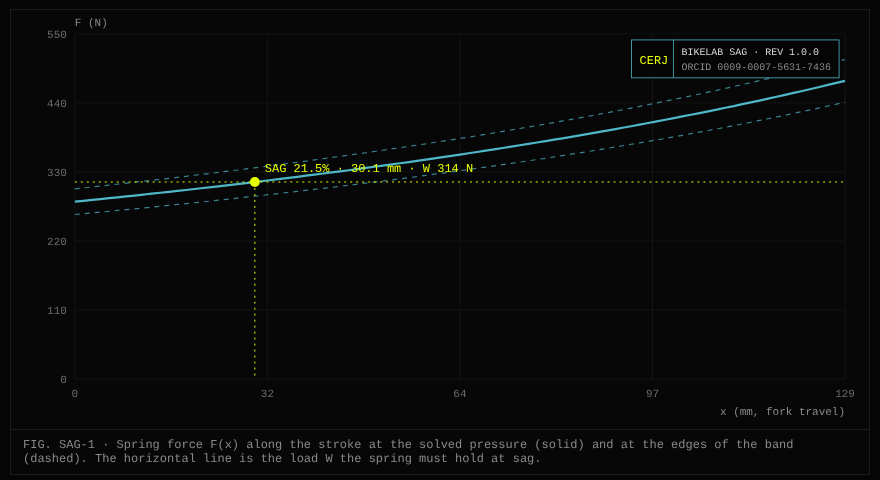
- Live demo, with the spring curve drawn: https://carlosravello-png.github.io/bikelab-sag-calculator/
- Full calculator: ES · EN · PT
Model: what the engine actually does
| Step | What the code does |
|---|---|
| Air spring | Positive chamber only: F(x, P) = P · A · (V0 / (V0 − A·x))^γ − Ff, with γ = 1.30 for every model |
| Volume | V0 = chamber volume minus installed tokens (each model carries its own volume and token volume) |
| Negative chamber | Not modelled separately. Each model carries a constant force term Ff that is subtracted |
| Load at sag | W = m · g · β / LR; β = 0.40 fork, 0.60 shock |
| Leverage (shocks) | Frame curve when catalogued (26 frames), else a generic curve by linkage type (6: Horst, VPP, DW, single pivot, Switch Infinity, high pivot), else a default by discipline (2.2 / 2.5 / 2.7 / 3.0) |
| Target sag | Middle of the discipline range (fork XC 15–20 %, Trail 20–23 %, Enduro 23–26 %, DH 25–28 %; shock 25–28 / 28–30 / 30–33 / 33–38 %), shifted by riding style |
| Pressure | Bisection on 20–500 psi until F(sag) = W (70 steps or 0.01 psi) |
| Band | Fixed ±15 / 10 / 7 / 5 % of the solved pressure by segment (entry / mid / mid-high / high) |
| Tokens | Tries 0–5 tokens and suggests the first whose end-stroke progression falls in the discipline window |
| Rebound / compression clicks | Heuristic formula; no validation published |
Database: 132 suspensions (102 forks, 30 shocks) from 16 brands: Fox, RockShox, Öhlins, SR Suntour, Manitou, Marzocchi, DVO, Cane Creek, X-Fusion, Formula, MRP, Push Industries, RST, Sturdy, Wintek, Zoom. Each model carries piston diameter, chamber volume, constant force term and token volume. Calibrated MTB suspension dataset: DOI 10.5281/zenodo.20735088.
Reproduce
python verify_sag.py   # independent verifier, standard library only
node check_engine.js   # the real engine, Node.js 18+
Each prints N/N checks passed and exits with code 0 (today: 55/55 and 15/15). check_engine.js also compares the engine with the model on 5,304 inputs (102 forks × 4 disciplines × 13 rider masses).
Differences with white paper v3.0 (February 2026)
The white paper on bikelabstudio.com describes more than the published engine does. This repository documents the engine as it is:
- The white paper speaks of a γ exponent calibrated per model between 1.00 and 1.40. The engine uses a single γ = 1.30.
- The white paper describes a dual-chamber model with an independent negative chamber. The engine models the positive chamber and a constant force term.
- The white paper reports Monte Carlo validation (10,000 iterations per model) and a confidence of 72–89 % by segment. Neither runs in the engine; the band shown to the rider is a fixed percentage. Those figures cannot be reproduced from what is published.
- The pages mention 10 brands and 33 frames; the database has 16 brands, 26 frames and 6 generic linkage curves.
Known limits
- For shocks without a catalogued frame, the wheel-sag percentage shown is computed against the shock stroke instead of the wheel travel, so it reads too high (e.g. 72.5 % instead of a value near 29 %). The pressure is not affected.
- Real air springs have a negative chamber, seal friction that varies with pressure, and temperature effects. None of these is modelled beyond the constant force term.
- The pressure is a starting point to be checked with a sag measurement on the bike.
License and citation
Engine, vectors and verifiers: CC BY 4.0.
Ravello Joo, C. E. (2026). BikeLab SAG Calculator (Version 1.0.0) [Software]. Zenodo. https://doi.org/10.5281/zenodo.24484751
All versions: DOI 10.5281/zenodo.24484750. Previous archived version (June 2026): DOI 10.5281/zenodo.20672790.

Badges

License
Software Heritage
Contributors
CRJ
BikeLab Studio
0009-0007-5631-7436